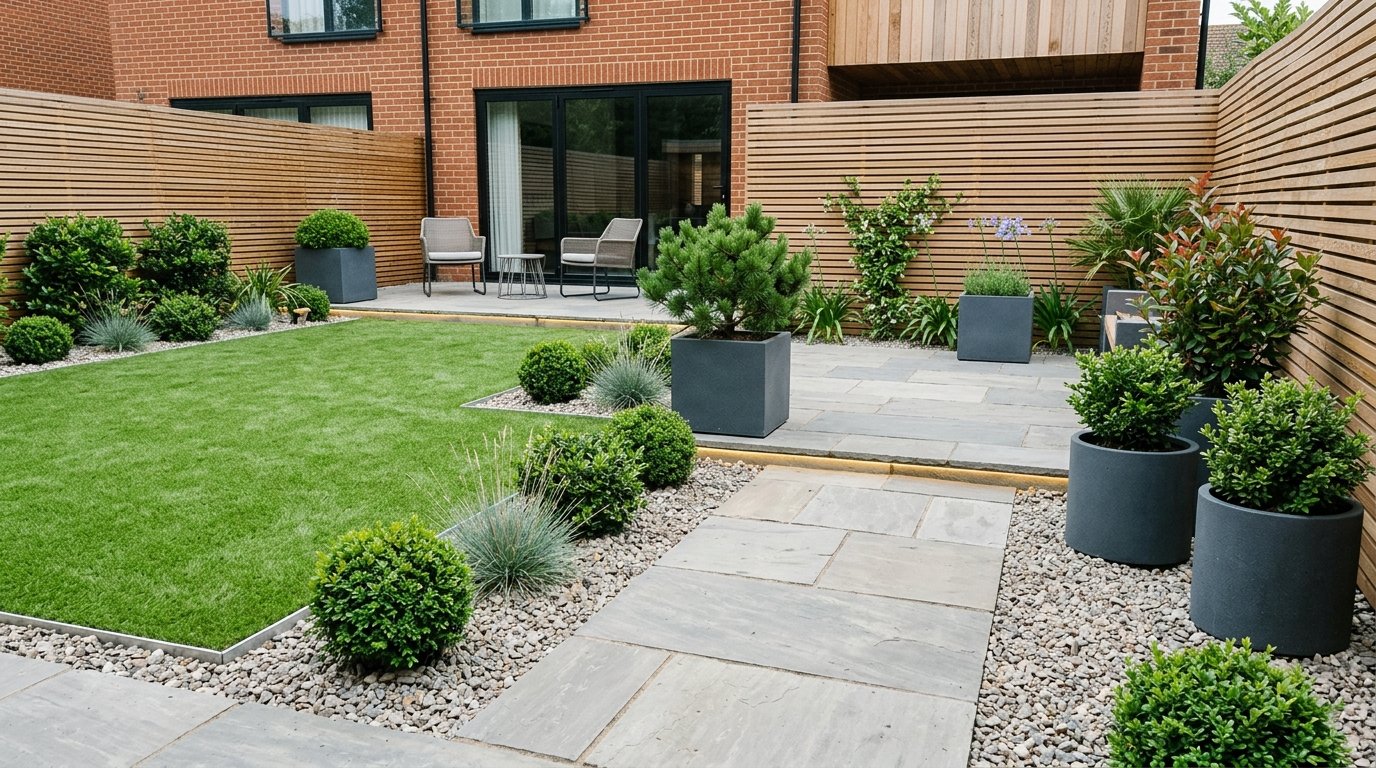
Quick Answer
Choose a patio when you want a solid, ground-level surface with a wide choice of paving finishes and straightforward furniture placement. Decking can be particularly useful where the garden has awkward levels or where a raised platform helps connect a doorway to the garden.
Neither option is maintenance-free. Patios need joint and surface care, while timber decking typically needs more ongoing treatment and cleaning. Composite systems reduce some timber maintenance but still require cleaning and correct installation.
Patio vs decking at a glance
Patios and decking can both create a practical outdoor living area, but they solve different garden problems. A patio forms a solid paved surface on a prepared base, while decking creates a raised or framed platform using timber, composite or another decking system.
The right choice depends less on which material is “best” and more on the site. Levels, drainage, access, shade, architecture and the amount of maintenance you are willing to do all matter.
| Consideration | Patio | Decking |
|---|---|---|
| Typical construction | Paving on a prepared sub-base and bedding system | Boards fixed to a supporting frame or substructure |
| Best for | Solid ground-level terraces and paths | Raised platforms and level changes |
| Maintenance | Cleaning, joint care and local repairs | Cleaning; timber may need coating/treatment; composite varies by product |
| Drainage | Requires correct falls or permeable design | Water passes through board gaps but still needs drainage beneath |
| Appearance | Stone, porcelain, concrete and block options | Timber or wood-effect linear appearance |
| Furniture | Stable solid surface | Stable when substructure and boards are correctly installed |
| Lifespan | Depends on product, base, installation and exposure | Depends on board material, substructure, detailing and maintenance |
Avoid choosing from a generic lifespan table. Poor groundwork can make expensive paving fail early, while well-detailed decking can perform very differently from a poorly ventilated platform.
When a patio makes sense
A patio is a natural choice when the ground can be prepared to the correct levels and you want a durable hard surface close to the house.
Common materials include:
- porcelain paving
- natural stone
- concrete slabs
- clay or concrete pavers
- permeable paving systems for suitable applications
The material affects appearance, surface texture, cleaning requirements and installation method. Choose a product that is intended for external use and provides appropriate slip resistance for the location.
Patios also integrate easily with paths, steps and planted borders, making them useful as part of a wider low-maintenance garden design.
When decking makes sense
Decking can create a level outdoor platform where the existing garden falls away or where a raised threshold makes a paved terrace more complicated.
Because the deck uses a substructure, the finished surface can bridge changes in ground level. This can be especially useful outside raised rear doors, around certain garden buildings or on sloping sites.
However, the void beneath the deck still needs careful design. Drainage, ventilation, vegetation, access and the durability of the supporting structure all matter. Hiding a wet drainage problem beneath a deck does not solve it.
Timber decking
Timber offers a natural appearance and can be cut and detailed flexibly. The maintenance requirement depends on species, treatment, exposure and desired appearance.
Timber can weather and change colour. Coatings or treatments may be used depending on the product, and algae can make shaded wet surfaces slippery if cleaning is neglected.
The substructure deserves as much attention as the visible boards. Poorly detailed joists or supports can retain water and deteriorate even when the top surface still looks reasonable.
Composite decking
Composite products are often marketed as low maintenance because they do not require the same treatment regime as many timber boards. That does not mean they never need care.
Leaves, dirt, food spills and algae can still collect on the surface. Expansion, fixing details, ventilation and substructure requirements vary by manufacturer, so installation should follow the chosen system rather than generic timber-decking habits.
Colour and heat performance can also differ between products. Request samples and view them outdoors before committing to a large area.
Porcelain and other patio surfaces
Porcelain has become popular for contemporary gardens because it can provide consistent colour and a relatively low-porosity surface. External porcelain requires suitable installation methods, edge details and a product designed for outdoor use.
Natural stone can provide more variation and character but may have different sealing and cleaning considerations depending on the stone.
Concrete paving covers a broad range of styles and specifications. The underlying base and drainage are often more important to long-term performance than the label on the slab.
Drainage: the issue both options must solve
A patio must be laid to suitable levels so surface water is managed away from the building and towards an appropriate drainage or permeable area. Decking lets rain pass between boards, but that water then reaches the ground below.
If the soil beneath is already compacted or waterlogged, the deck can conceal a persistent wet area. The RHS notes that waterlogging is commonly associated with heavy or compacted soil and that drainage systems need a suitable place for surplus water to go. citeturn982258search0turn982258search4
Before either installation, assess where rainwater currently travels and whether the project will increase runoff onto the house, neighbour or public area.
Our guide to garden drainage solutions covers this in more detail.
Levels and damp-proof course considerations
Surfaces close to a house need careful level design. Raising paving or decking too high against external walls can interfere with damp-management details, ventilation or door thresholds.
Do not simply match the finished surface to the internal floor without checking building details. A contractor should consider the existing damp-proof course, air bricks, drainage channels and required thresholds.
Where level access is needed for accessibility, it can be designed properly rather than achieved by burying building details beneath the new surface.
Which is more slippery?
Any outdoor surface can become slippery when wet, shaded, contaminated with algae or poorly maintained.
Textured external paving and appropriately selected decking can provide good grip, but performance varies by product. Smooth interior-style tiles should not be assumed suitable outside.
In north-facing or heavily shaded gardens, regular cleaning may be necessary whichever surface you choose. Design for drainage and sunlight where possible rather than relying on a chemical treatment to solve persistent dampness.
Maintenance comparison
Patio maintenance
A patio may need:
- sweeping and washing
- weed or moss management at joints
- replacement or repair of damaged jointing
- stain treatment appropriate to the paving
- local lifting and relaying if movement occurs
Pressure washing needs care because aggressive use can damage some surfaces or jointing systems.
Deck maintenance
Decking may need:
- sweeping between boards
- removal of algae and organic debris
- checks for loose fixings or damaged boards
- timber treatment where appropriate
- inspection of accessible substructure
Composite boards have their own cleaning and care instructions.
Furniture, barbecues and everyday use
A flat patio is straightforward for dining tables, chairs and wheeled equipment. Decking is also suitable when correctly constructed, but narrow legs can interact with board gaps and care is needed with heat sources.
Barbecues, fire pits and outdoor heaters need to be used in accordance with product instructions and safe clearances, particularly around combustible timber or composite materials. Do not assume a heat mat makes every fire appliance suitable for every deck.
Children, pets and accessibility
Think about splinters and gaps on timber, surface temperature in direct sun, step edges, handrails where required and whether wheeled access is needed.
A patio can be easier for pushchairs and wheelchairs if levels are designed correctly. Decking can create ramps or raised connections, but its structural design becomes more important where it forms an access route.
Planning permission
Many ordinary rear-garden patios and decks fall within normal domestic landscaping, but planning considerations can apply to raised platforms, listed buildings, flats, restricted properties or significant changes in level.
Do not apply the front-garden driveway rule to every patio. Planning Portal specifically distinguishes front-garden paving rules from other patios and driveways. citeturn982258search2
If the project creates a large raised deck, changes boundaries or sits within a constrained property, check the current Planning Portal and local authority guidance.
Which looks better?
Appearance is subjective, but the architecture of the house can help narrow the choice.
Porcelain can suit contemporary extensions, while natural stone may complement older brick or stone properties. Timber can soften a modern façade and connect naturally with planted gardens. Composite offers a more uniform finish.
Use the material in more than one element where appropriate. Repeating a paving tone in a path or matching deck lines with the house can make the project feel intentional rather than added on.
Can you combine patio and decking?
Yes. Larger gardens can use both materials to define zones, for example a paved dining terrace close to the kitchen and a raised deck at the end of a sloping garden.
The transition between materials needs careful level and drainage design. Avoid introducing small areas of many different finishes purely for variety; a limited palette is usually easier to maintain and visually calmer.
Proper Trades can help design and install patios, decking and wider landscaping projects across the Midlands.
Proper Trades connects homeowners and businesses across the Midlands with request a free quote.
For further guidance, read our year-round garden design guide.
For further guidance, read our paving surface comparison guide.
Frequently asked questions
1. Is a patio lower maintenance than decking?
Often compared with timber decking, a well-installed patio can require less routine treatment, but it still needs cleaning and joint maintenance. Composite decking can reduce some timber maintenance but is not maintenance-free.
2. Is decking better for a sloping garden?
It can be. A structural deck can create a level platform above a slope, but foundations, drainage, height, guarding and planning considerations need to be addressed properly.
3. Can I lay a patio directly over soil?
A durable patio normally needs a properly designed and compacted base and bedding system suited to the paving. Laying slabs directly on topsoil is unlikely to provide stable long-term support.
4. Does water drain through decking?
Rain passes between the boards, but it still reaches the ground below. The area beneath the deck needs suitable drainage and ventilation; decking should not be used to hide unresolved waterlogging.
5. Does a patio need planning permission?
Many rear-garden patios do not require a planning application, but site-specific restrictions can apply. Front-garden paving has separate surface-water rules, and raised platforms or listed/restricted properties can need additional checks.
6. Can patio and decking be used together?
Yes. They can define different garden zones, particularly on sites with changing levels. Keep the material palette controlled and plan the transition, drainage and finished levels together.
Need Professional Help with Your Project?
Proper Trades connects you with vetted, qualified trade specialists across the Midlands. Tell us your requirements, and we will review your project and present a single clear quote.
Enquiry Received
Thank you. We will review your project and get in touch shortly.